India (English / EUR)

FAQ
Not sure why you should be measuring CO2 level or what is NDIR? No worries, we've got you covered
Search By Topic
FAQ
Settings can be adjusted using the button on the side of the sensor or through the Aranet Home mobile app.
In the United States, radon is measured in pCi/L (picocuries per liter).
The EPA action level is 4.0 pCi/L. If long-term readings are at or above this level, mitigation is recommended. The EPA also suggests considering mitigation between 2.0 and 4.0 pCi/L.
There is no completely safe level of radon exposure. The goal is to reduce indoor radon concentrations as much as reasonably possible.
A radon test kit is typically a short-term or long-term passive sampling device that must be mailed to a laboratory for analysis.
A digital radon detector like Aranet Radon Plus continuously measures radon levels in real time. It allows you to:
- See daily and seasonal fluctuations
- Monitor long-term exposure trends
- Validate mitigation system performance
- Receive alerts when levels rise
Continuous monitoring provides more context than a one-time test.
No registration is necessary. You can use Aranet Radon Plus sensor as a standalone device or sync it with the free Aranet Home app for a comprehensive data history and analysis.
Aranet Radon Plus sensor updates the radon levels reading every 10 minutes, with the first highly reliable result in just one hour.
Aranet Radon Plus uses an ionization chamber that detects alpha decay events from radon gas. The device calculates concentration levels and displays results in pCi/L.
- First reading: approximately 10 minutes
- Reliable 1-hour average
- Long-term 24h / 7d / 30d averages for improved accuracy
This method is commonly used in professional continuous radon monitors.
For residential use, radon detectors should be placed:
- On the lowest livable level of the home (basement or ground floor)
- At least 20 inches above the floor
- Away from drafts, direct sunlight, and high humidity areas
- Not in kitchens, bathrooms, or laundry rooms
Placement affects readings. Follow EPA and manufacturer guidelines for best results.
The color-coded bars (green, yellow, red) indicate the radon concentration levels and warn you of unhealthy levels. The thresholds for these bars can be adjusted via the Aranet Home app. The default thresholds are set following World Health Organization (WHO) Radon guidelines.
You’ll see the first result about 10 minutes after setup.
Radon levels fluctuate daily and seasonally. Short-term readings provide an initial indication, but long-term monitoring gives a more accurate picture of exposure.
Continuous monitoring over weeks or months is recommended to understand your home's true radon profile.
No. Aranet Radon Plus does not require registration, subscriptions, or recurring fees. The device works independently and syncs with the Aranet Home app for history and alerts.
Accuracy stabilizes within 1 hour of operation. Long-term averages (24h, 7d, 30d) refine precision further.
The green, yellow, and red bars indicate radon concentration levels.
Default thresholds can be adjusted in the Aranet Home app. For U.S. users, many homeowners align thresholds with the EPA action level of 4.0 pCi/L.
Place it on a flat surface in the lowest lived-in level, such as a basement or ground-floor room. Keep it away from direct sunlight and high humidity (over 85%).
Yes. It’s battery-powered and cable-free. Bluetooth is optional and used only if you connect it to the Aranet Home app.
If long-term readings exceed 4.0 pCi/L:
- Confirm with continued monitoring or a second test.
- Contact a licensed radon mitigation professional.
- Install a mitigation system if recommended.
Continuous monitoring helps verify mitigation effectiveness over time.
A CO2 monitor measures indoor carbon dioxide concentration in ppm (parts per million). CO2 levels are commonly used as an indicator of ventilation effectiveness. Rising indoor CO2 levels may signal insufficient air exchange in homes, offices, or classrooms.
Yes. Aranet Radon Plus can display radon concentration in pCi/L, the standard unit used in the United States.
Outdoor air typically contains around 400–420 ppm of CO2. Indoor levels vary depending on occupancy and ventilation.
- 400–800 ppm: Well ventilated
- 800–1200 ppm: Moderately elevated
- 1200+ ppm: May indicate insufficient ventilation
CO2 is not toxic at typical indoor levels, but high concentrations can indicate poor air exchange.
For accurate readings:
- Place at breathing height (about 3–6 feet above floor)
- Avoid direct airflow from windows or vents
- Keep away from kitchens and immediate breathing zones
- Avoid direct sunlight and high humidity areas
Proper placement ensures reliable ppm readings.
Aranet4 HOME uses a true non-dispersive infrared (NDIR) sensor to measure CO2 directly. Unlike estimated “eCO2” devices, NDIR sensors detect actual CO2 molecules, providing stable long-term accuracy.
The device supports automatic background calibration in regularly ventilated spaces. For best accuracy, periodic exposure to fresh outdoor air is recommended.
The buzzer activates when CO2 levels exceed a user-defined threshold. The default alert level can be adjusted in the Aranet Home app.
No. Aranet4 HOME measures carbon dioxide (CO2), not carbon monoxide (CO). A dedicated CO alarm is required for carbon monoxide detection.
For most users, the easiest way to renew or extend is directly through your existing Aranet Cloud workspace:
- Log in to your Aranet Cloud account.
- Navigate to the Workspace section.
- Look for the Shop tab.
- From here, you can typically choose to pay for a renewal via Credit Card (Visa/Mastercard) for immediate processing.
- If you prefer to pay via Invoice (Bank Transfer), you can generate a prforma invoice and do offline payment.
You can purchase a license for a shorter duration (1 month), using direct purchase in the Aranet Cloud platform.
Here is how you can obtain a license for less than one year:
Monthly Billing via Aranet Cloud
The most direct way to pay for less than a year is through the "Pay as you go" model within your workspace.
- Pricing: Standard Aranet Cloud Pro licenses start at about €15/month.
- Method: 1. Log in to your Aranet Cloud account.
2. Go to Workspace > Shop.
3. Choose your plan (Basic or Pro).
4. Pay using credit card or wire transfer.
Free Alternative
If your goal is simply to manage your devices and you don't need historical data storage, you can use the Aranet Device Management license.
- Cost: Free.
- Duration: Unlimited.
- Function: Allows you to pair sensors, update firmware, and see real-time status without a paid subscription. This is a great "bridge" if you are between paid periods.
Aranet Cloud Trial
If you are a new user, you are eligible for a 30-day free trial of the Cloud Pro features. This allows you to test the full software suite for one month at no cost before deciding on a shorter or longer paid term.
Once your trial ends, you can continue using Aranet Cloud with an activation code or by purchasing a license directly.
Activation code must be used within 6 months. Once activated, your Aranet Cloud license is valid for 1 year starting from the activation date.
Aranet2 HOME measures temperature within ±0.3°C and relative humidity within ±3%. These specifications come from laboratory-graded sensor components. For context, many consumer-grade monitors on the market have accuracy tolerances of ±1°C or wider. The tighter measurement range makes Aranet2 HOME suitable for environments where precision matters, such as storage rooms, nurseries, or humidity-sensitive spaces.
Most health and building guidelines recommend keeping indoor relative humidity between 30% and 60%. Below 30%, air becomes dry enough to irritate skin, eyes, and airways. Above 60%, conditions become favorable for mold growth, dust mites, and condensation on surfaces. Aranet2 HOME tracks humidity continuously so you can identify when levels drift outside this range and take corrective action.
Aranet2 HOME runs on two standard AA alkaline batteries and is designed to operate for up to 4 years under typical conditions. The E-Ink display is a key factor here. Unlike backlit LCD screens, E-Ink consumes power only when the display refreshes, which significantly extends battery life. Batteries are included in the box.
Yes. Aranet2 HOME syncs with the free Aranet Home app via Bluetooth. The app logs temperature and humidity data over time, allowing you to review trends by day, week, or month. This is useful for tracking seasonal changes, verifying that a dehumidifier or HVAC system is working, or confirming conditions in a room you are not physically in.
Place the device in the room where you want to monitor conditions. Common locations include bedrooms, living rooms, basements, closets, nurseries, and storage areas. For accurate readings, avoid placing the monitor in direct sunlight, near heating or cooling vents, or in areas with poor air circulation. Wall mounting is supported.
Mold growth typically begins when relative humidity stays above 60% for extended periods, especially in poorly ventilated areas like basements, closets, and bathrooms. Aranet2 HOME provides continuous humidity monitoring so you can identify elevated levels before mold becomes visible. Reviewing long-term trends in the Aranet Home app helps you determine whether ventilation, a dehumidifier, or other action is needed.
A basic digital hygrometer shows the current reading on a screen. Aranet2 HOME does that, but also logs data over time via the Aranet Home app, allowing you to track trends rather than relying on a single snapshot. Additionally, the ±0.3°C temperature accuracy and ±3% humidity accuracy are significantly tighter than most basic hygrometers, which typically range from ±1°C to ±2°C.
No. Aranet2 HOME works independently out of the box. The Aranet Home app is free to download and does not require a subscription, account registration, or recurring fees. The device operates as a standalone temperature and humidity monitor with or without the app.
Aranet2 HOME measures 70 x 70 x 24 mm (approximately 2.8 x 2.8 x 1 inch) and weighs 100 g (3.5 oz) including batteries. The compact form factor fits on a shelf, nightstand, or wall mount without taking up significant space.
Most guidelines recommend keeping indoor temperatures between 18°C and 24°C (64°F to 75°F) for general living spaces. Bedrooms are often kept slightly cooler. Temperature and humidity are closely linked: warm air holds more moisture than cool air, which is why humidity tends to rise in summer and drop in winter. Monitoring both measurements together gives a more complete picture of indoor comfort than tracking either one alone.
Seasonal shifts affect indoor humidity significantly. In winter, heating systems dry out indoor air, often pushing humidity below 30%. In summer, warm outdoor air raises indoor moisture levels, sometimes above 60%. Daily activities like cooking, showering, and drying laundry also contribute. A continuous temperature and humidity monitor reveals these patterns over time, making it easier to decide when to use a humidifier, dehumidifier, or adjust ventilation.
A radon test kit is a passive device (typically a charcoal canister or alpha track strip) that you place in your home for a set period, then mail to a laboratory for analysis. You receive a single average number days or weeks later. A continuous radon monitor like Aranet Radon One measures radon levels in real time, 24 hours a day, and displays results on the device itself. Because radon levels fluctuate daily and seasonally, continuous monitoring provides a much more complete picture of your home's actual exposure than a one-time test result.
Aranet Radon One uses an ionization chamber sensor that detects alpha particles released during the radioactive decay of radon gas. The device counts decay events over time and calculates radon concentration in Bq/m3. It provides a first reading in approximately 10 minutes, a reliable 1-hour average, and progressively more accurate averages over 24 hours, 7 days, and 30 days. Long-term averages are accurate to ±10%.
The World Health Organization recommends a reference level of 100 Bq/m³ (2.7 pCi/L) for homes. Many countries set national action levels between 100 and 300 Bq/m³ (2.7–8.1 pCi/L). If your long-term average radon reading consistently exceeds your country's reference level, professional radon mitigation is recommended. Aranet Radon One displays color-coded indicators (green, yellow, red) that you can align with WHO or national reference levels through the Aranet Home app.
Place the radon monitor on the lowest regularly occupied floor of your home, typically a basement or ground-floor living area. Position it at least 50 cm (20 inches) above the floor, away from exterior walls, windows, doors, and areas with high airflow. Avoid kitchens, bathrooms, and laundry rooms. Radon enters from the ground, so lower floors generally have higher concentrations.
Aranet Radon One runs on two standard AA alkaline batteries and is designed to operate for up to 7 years under typical conditions. This is made possible by the E-Ink display, which draws power only during screen refreshes, and proprietary energy management technology (patent-pending). Batteries are included in the box. No power outlet, charging cable, or USB connection is needed.
No. Aranet Radon One operates independently without Wi-Fi. The device measures, calculates, and displays radon levels entirely on its own. The Aranet Home app connects via Bluetooth to retrieve stored data, view trend charts, and configure alert thresholds. Bluetooth syncing requires the app to be within range, but the monitor itself does not depend on any network connection to function.
The green, yellow, and red bars indicate radon concentration levels relative to configurable thresholds. Default thresholds are set following WHO radon guidelines. You can adjust these thresholds through the Aranet Home app to match your national reference levels. Green indicates levels within the recommended range. Yellow indicates levels approaching the action threshold. Red indicates levels that exceed the reference level and warrant further investigation or mitigation.
Radon levels fluctuate from hour to hour and season to season. A minimum monitoring period of several weeks is recommended before drawing conclusions. Longer monitoring periods (3 months or more, ideally across both heating and non-heating seasons) produce a more reliable long-term average. If readings consistently exceed your national reference level over an extended period, contact a licensed radon mitigation professional.
Yes. Aranet Radon One is battery powered and fully portable. You can move it to different rooms to compare radon levels across your home. Keep in mind that each time you relocate the device, it needs time to establish a new baseline in the new location. Allow at least 24 hours in the new position before interpreting results. The Aranet Home app stores historical data from all locations.
A properly performed short-term test provides a valid snapshot for the testing period. However, radon levels can vary significantly from day to day and across seasons. A continuous radon monitor measures these fluctuations over time and produces long-term averages that are more representative of your actual annual exposure. Health agencies including WHO recommend long-term measurements for the most reliable assessment of residential radon risk.
A radiation detector measures ionizing radiation, the type of radiation that can displace electrons from atoms and potentially damage living tissue. Aranet Radiation measures two values: dose rate (µSv/h), which indicates the current level of radiation exposure per hour, and cumulative total dose, which tracks your accumulated exposure over time. Together, these give you both an immediate snapshot and a long-term exposure history.
Yes. Background radiation is present everywhere and comes from natural sources including soil, rock, cosmic rays, and trace radioactive elements in building materials and food. Typical background radiation levels range from 0.05 to 0.20 µSv/h depending on location, altitude, and local geology. A radiation detector helps you establish what is normal for your specific environment so you can recognize when levels change.
Aranet Radiation is calibrated for gamma (γ) radiation in a certified laboratory before shipping. The sensor is verified against reference radiation sources to ensure measurement accuracy. Calibration details and specifications are documented in the product datasheet available on this page. For context, laboratory calibration is the standard used by professional dosimetry instruments and is not typically performed on consumer-grade Geiger counters.
Dose rate (measured in µSv/h) tells you how much radiation you are receiving per hour at this moment. Total dose (measured in µSv or mSv) tells you how much radiation you have received in total over a period of time. Think of dose rate as your current speed and total dose as your total distance traveled. Aranet Radiation tracks both values simultaneously on its E-Ink display.
For general background monitoring, place the device in a frequently occupied room such as a living area or bedroom. If you suspect elevated radiation from building materials, soil, or stored items, place the detector near the suspected source. Avoid placing it directly on or against metal surfaces, which can affect readings. The device is portable, so you can move it between rooms to compare levels across different areas of your home.
Aranet Radiation runs on two standard AA batteries and is designed to operate for up to 4 years under typical conditions. The E-Ink display draws power only when refreshing, which significantly extends battery life compared to backlit LCD or OLED screens used in most Geiger counters. Batteries are included in the box.
No. Aranet Radiation operates independently without Wi-Fi or any network connection. It measures, calculates, and displays radiation levels on its own. The Aranet Home app connects via Bluetooth when you want to view historical data, export dose logs, or configure alarm thresholds. The detector functions fully without the app.
Aranet Radiation has a color-coded visual alarm (green, yellow, red) and an audible buzzer. Alarm thresholds are based on scientific exposure guidelines and can be customized through the Aranet Home app. Green indicates levels within the normal background range. Yellow indicates elevated levels that warrant attention. Red indicates levels that exceed the configured threshold. The audible alarm can be turned off if preferred.
Yes. The device is battery powered, weighs 220 g (7.8 oz), and does not require Wi-Fi or power cables. It is designed for both fixed home monitoring and portable use. A Navy Blue Travel Case is available as an accessory. This makes it useful for checking radiation levels in hotel rooms, rental properties, or unfamiliar locations.
Aranet Radiation is calibrated for gamma (γ) radiation, which is the most penetrating form of ionizing radiation and the primary concern for environmental background monitoring. Refer to the product datasheet for complete detection specifications. (Verify with Aranet: does the sensor also detect beta radiation? If yes, state both.)
All purchase orders are processed within two working days from the order date.
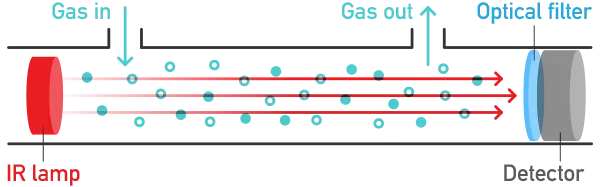
Aranet4 uses a non-dispersive infrared (NDIR) sensor to measure CO2 levels. The device features a small gas chamber with an infrared light source, where CO2 absorbs the light. An optical filter in front of the detector then filters out all light except the wavelength absorbable by CO2 molecules, enabling a precise CO2 concentration level measurement. This CO2 reading method offers higher precision than regular electro-chemical sensors, as it uniquely detects carbon dioxide with no interference from other gases. Furthermore, the NDIR sensor has a much longer lifespan and requires less recalibration than other sensors.
Aranet Home app allows you to view 90-day historical data, helping you notice and analyze patterns in radiation levels. It also enables you to adjust device settings, including measurement intervals and alarm thresholds, for personalized monitoring.
To set up a buzzer, follow these steps: 1) Open your Aranet4 App; 2) Click on the “Gear” icon in the top right corner; 3) Select 'Buzzer' and choose 'On, once' or 'On, every time' depending on your preference.
High CO2 levels can negatively affect your well-being, comfort, and productivity. For example, if CO2 levels reach 1000 ppm, your cognitive abilities drop by 15%. At 1400 ppm and above, they decrease by a staggering 50%. Additionally, CO2 monitoring helps to prevent the spread of COVID-19, as CO2 level is a good proxy for airborne infection risk.
You can extend the warranty of your Aranet HOME products by an additional 12 months by registering the product and agreeing to receive email updates from SAF Tehnika. You can withdraw your consent to receive emails anytime without affecting the extended warranty.
Simply go into your Aranet Home App, and tap onto the dashboard view in the top right corner. Once there, tap on the “Sharing” icon in the top right corner and choose how you would like to share or download it.
Detecting ionizing radiation is crucial for ensuring safety and health in environments where radiation levels may pose a risk. Ionizing radiation can damage living tissue and increase the risk of cancer, particularly with prolonged exposure. By monitoring ionizing radiation, you can identify and mitigate potential hazards in your home or workplace, adhere to safety guidelines, and maintain a healthy living environment.
The sensor features both visual and audible alarm systems that activate when radiation levels exceed scientifically guided safe limits. These alarms are designed to promptly notify you of any environmental safety concerns.
We use DPD and DHL Express for deliveries within Latvia and the EU, DHL Express for global deliveries, and FedEx for shipments to the United States. We do not ship sensors to PO boxes; however, if your purchase consists only of stickers, they can be delivered to PO boxes.
Indoor humidity levels should range from 30% to 50%. This range supports comfort, health, and helps prevent the growth of mold.
Yes, the instant audible ionizing radiation detection (auditory pulse counter) feature comes with a buzzer that can be easily switched off (2nd switch behind the batteries) if you prefer not to have audible alerts.
While the sensor is portable and can be used in various environments, direct sunlight and high humidity (e.g. rainy days) should be avoided. Sun exposure can negatively affect the E-Ink display.
Aranet4 is calibrated at the factory, so if you’ve just received your new device, there is no need to calibrate it immediately. We recommend calibrating Aranet4 once a year.
Aranet4 can be calibrated either automatically or manually at home. In automatic calibration mode, the Aranet4 device needs to be exposed to fresh air with approximately 420 ppm of CO2 (for example, outdoors or in a room with very good air exchange) for about 8 hours during each 30-day operation period.
For manual calibration, the Aranet4 device must be exposed to fresh air (around 420 ppm of CO2), such as in a forest. The environment should be stable (unchanging) for 30 minutes during the calibration. Maintain a distance of at least 1 meter from the device during the calibration process to ensure the CO2 from your breath doesn’t affect the calibration. To initiate manual CO2 calibration, change the 1st switch position at the back of the device, behind the batteries, from MANUAL to AUTO and back to MANUAL, keeping a maximum of 1 second between each movement. The batteries must be installed in the device. The calibration progress will be displayed on the device’s screen.
For a reference background CO2 level, please check a global outdoor CO2 level map. Manual calibration can also be performed using Aranet Home app. Instructions for manual calibration via the app are available in the Aranet4 Calibration Tutorial.
If switched on, the buzzer emits a sound when the CO2 concentration reaches the red threshold, which is set by default to 1400 ppm. To change it, follow these steps:
1) Open your Aranet4 app;
2) Click on the 'Gear' icon in the top right corner;
3) Select 'Warning thresholds' under 'Advanced';
4) Choose 'Custom' and change the thresholds as desired.
Aranet4 sensor must be within Bluetooth range to change settings within the app. If the sensor is within Bluetooth range, you can try changing the warning thresholds to custom settings (e.g., 300 ppm for yellow; 400 ppm for red, so it beeps if it is lost somewhere with fresh air). Alternate the buzzer between 'Off' and 'On Every Time' to create beeps.
If you’re facing issues with your product, please fill in the returns form.
Due to regulations of the European Union and Latvia, there are restrictions for delivering products to certain territories and countries. Please contact us at sales_support@aranet.com for specific information regarding your location.
Aranet Radiation sensor can detect γ (gamma), β (beta), and X-rays. However, it is designed to measure γ (gamma) radiation levels with high accuracy, thanks to its calibration using a Cs-137 radiation source. While it can detect β (beta) radiation and X-rays, it is not calibrated to provide precise quantitative measurements for these types.
It is possible to change the temperature measurement unit type separately both on the Aranet2 Home sensor display and in the Aranet Home app. The temperature can be displayed in either Celsius or Fahrenheit degrees in both places.
The temperature measurement unit on Aranet2 Home sensor display can be changed with the help of the second dip switch in the battery compartment.
Upon reaching the limit, the device will update the total dose reading but stop increasing the accumulation time. You should reset the total dose reading using the button on the back of the device or through Aranet Home mobile app before reaching this limit to ensure continuous monitoring.